
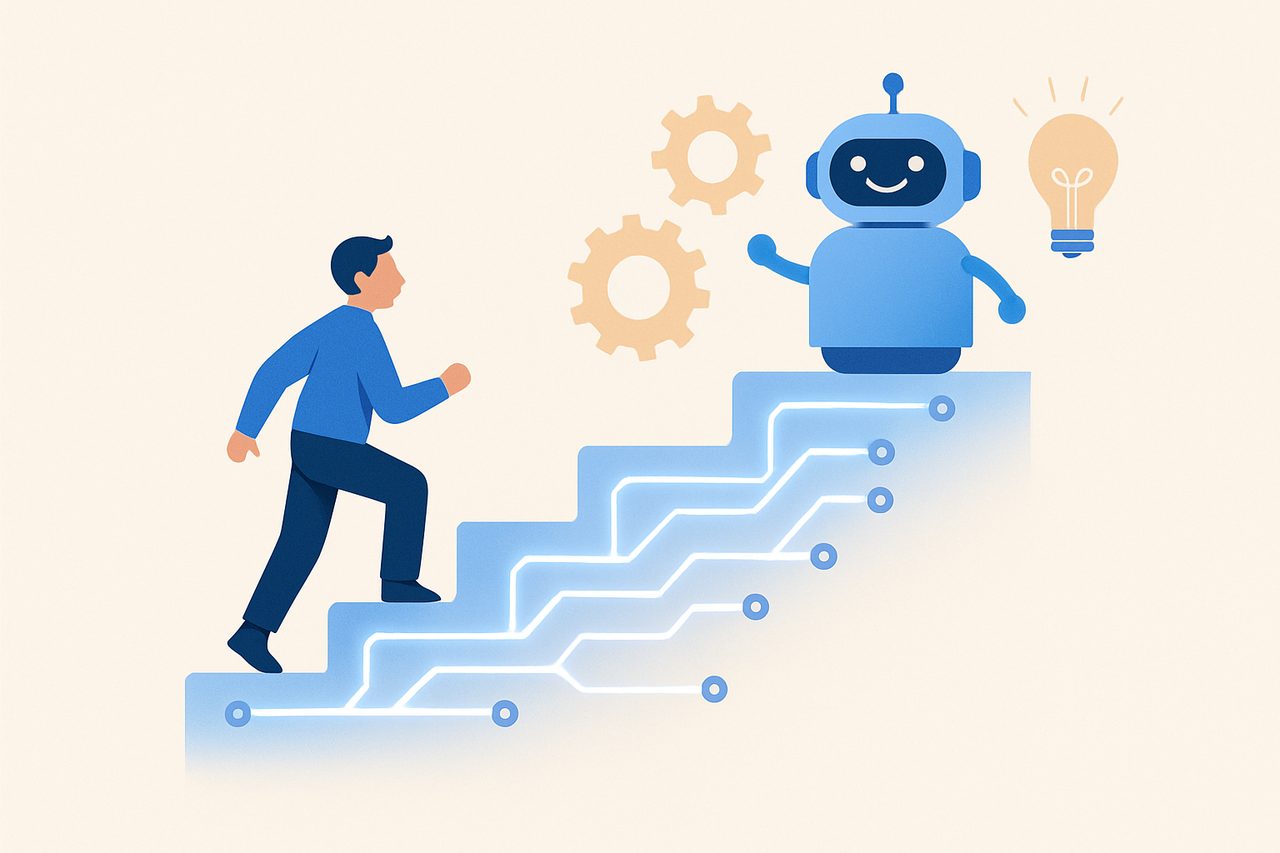
 AI Learning
How to Learn AI Skills as a Beginner: A Practical Guide
To learn AI skills as a beginner, start by understanding what artificial intelligence actually does, then get hands-on with free or low-cost AI tools, learn the basics of how models are built and prompted, and finally prove your skills through small projects and a certificate. You do not need a computer science degree or advanced math to begin—curiosity and consistent practice matter far more in the early stages.
What "AI skills" really means
AI skills fall into two broad groups, and beginners often only need the first to start adding value at work.
- Using AI tools: Writing effective prompts, working with chatbots, generating images, summarizing documents, and automating repetitive tasks. This is the fastest path to results.
- Building AI systems: Understanding machine learning, training models, and using languages like Python. This is deeper and takes longer, but it is not required to be useful with AI today.
Decide which goal fits you. A marketer or teacher may only need tool fluency, while someone aiming for a data or engineering role will eventually need the building skills.
A step-by-step learning path
- Learn the vocabulary. Understand terms like model, training data, prompt, token, hallucination, and machine learning. Knowing the language removes most of the confusion.
- Use a chatbot every day. Pick a free assistant and use it for real tasks—drafting emails, planning, brainstorming, explaining concepts. Daily use builds intuition faster than reading.
- Master prompting. Learn to give clear context, examples, a role, and a desired format. Good prompting is the single most transferable beginner skill.
- Understand how models work at a high level. You do not need the math, but knowing that models predict patterns from data helps you judge when to trust output.
- Try a structured course. A guided course saves time by sequencing concepts logically instead of leaving you to piece together scattered videos.
- Build small projects. Automate a personal task, create a custom assistant, or analyze a spreadsheet with AI help. Projects turn knowledge into skill.
Free and low-cost ways to practice
You can build real skills without spending much:
- Free tiers of popular chatbots and image generators let you experiment daily.
- Spreadsheet and document tools increasingly include built-in AI features to test.
- Public datasets and beginner notebooks let you explore data without setup.
- Affordable structured courses fill the gaps that free videos leave. On PickAClass, each certificate course is a flat $4.99 one-time payment with no subscription, which makes it easy to take a focused class without an ongoing commitment.
Do you need to learn to code?
Not to start. Many high-value AI tasks today are done entirely through natural language. However, learning the basics of Python unlocks deeper work—data analysis, automation, and building with AI libraries. A reasonable approach is to become confident with AI tools first, then add light coding once you know what you want to build.
If you want to go the technical route
- Start with Python fundamentals.
- Learn basic statistics and how data is cleaned and organized.
- Move into core machine learning concepts: training, testing, and evaluating models.
- Practice with small, real datasets rather than only tutorials.
How to stay focused and avoid overwhelm
AI moves quickly, and that pace can be paralyzing. Keep it simple:
- Pick one goal at a time. Tool fluency or building—not both at once.
- Learn just enough to do the next task. Apply immediately instead of stockpiling theory.
- Ignore the hype cycle. Fundamentals like clear prompting and critical thinking outlast any single trending app.
- Set a weekly rhythm. Even 30 minutes a few times a week compounds over months.
Prove your skills
Once you can use AI confidently, show it. Build a small portfolio—screenshots of projects, a custom assistant you created, or a workflow you automated. Adding a course certificate gives employers a verifiable signal that you completed structured learning. You can see what one looks like on the sample certificate page, and browse beginner-friendly options across the categories to find a topic that matches your goal.
The bottom line
Learning AI as a beginner is less about mastering complex math and more about building practical habits: understand the basics, use the tools daily, practice prompting, complete a focused course, and create small projects you can point to. Start narrow, stay consistent, and let real tasks guide what you learn next.